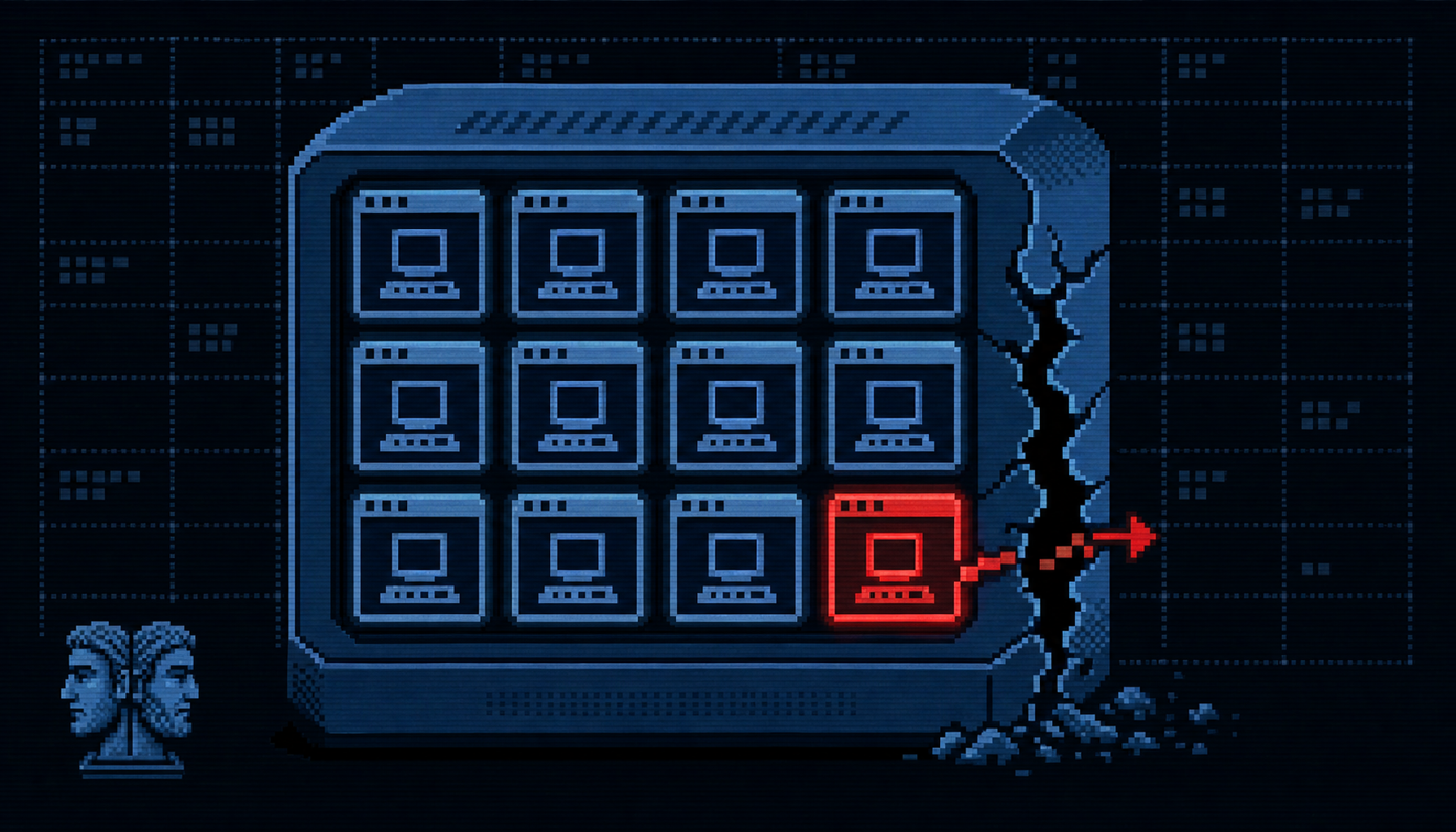
A newly disclosed use-after-free in Linux's KVM hypervisor, nicknamed Januscape and tracked as CVE-2026-53359, can be triggered from inside a guest virtual machine to corrupt the host kernel's shadow page-table state. The public proof-of-concept crashes (panics) the host — on a multi-tenant box, that takes down every other VM on the same physical machine. The researcher who found it says a separate, unreleased version of the exploit escalates the same bug into full code execution as root on the host. The flaw lives in the shadow MMU code KVM shares across Intel and AMD, has been present for roughly 16 years, and was fixed upstream in stable kernels shipped July 4, 2026. This is a serious problem for anyone running VPS, cloud, or shared virtualization hosting. No CVSS score has been assigned yet — don't wait for one.
What the Vulnerability Is
To run a VM, KVM maintains its own private set of page tables ("shadow pages") that mirror the guest's memory layout. When it needs one of these tracking pages, it tries to reuse an existing one rather than allocate fresh.
The bug: KVM matched candidate shadow pages by memory address (guest frame number) alone and ignored the role — the type of tracking page. Two different types of shadow page can live at the same address but do completely different jobs, so KVM would sometimes grab and reuse the wrong kind. That mismatch scrambles KVM's internal records of which page belongs where. Once those records are inconsistent, a freed tracking page can still be referenced — a classic use-after-free.
Most of the time the kernel notices the corruption and deliberately shuts itself down to avoid doing worse damage. That self-panic is what the public demonstration triggers: a guest with root and a loadable kernel module can reliably knock over the entire host in seconds to minutes of racing. The rarer, worse outcome is when the freed shadow page is reallocated for another purpose before cleanup runs — the cleanup then writes into memory KVM no longer owns. The attacker controls where that write lands (not what value is written), and that limited primitive can be worked up into running code on the host.
The behaviour is identical on Intel and AMD; only the final step of turning the write into full control differs per vendor. The fix, written by KVM maintainer Paolo Bonzini, is a one-line change to kvm_mmu_get_child_sp() so a shadow page is only reused when both the frame number and the role.word match.
Why It Matters
- This is a hypervisor isolation break, not just a local bug. The whole promise of virtualization hosting is that one tenant cannot touch another. A guest-to-host escape voids that boundary.
- Denial of service is trivial and public. The released PoC reliably panics the host. On a shared node, one malicious (or compromised) VM can take down every neighbouring customer's VM.
- Full host takeover is claimed. The researcher reports a withheld exploit that runs code as root on the host, which would expose every other guest on the machine to that root access.
- It hits both Intel and AMD. This is described as the first guest-to-host KVM exploit demonstrated to trigger on both x86 vendors — most hosts are in scope regardless of CPU brand.
- Bonus LPE on some distros. On distributions where
/dev/kvmis world-writable (mode 0666, e.g. RHEL), the same bug can also be used as a plain local privilege escalation to root — no VM tenancy required. - Long tail. The vulnerable code shipped in August 2010 (kernel 2.6.36 era), so essentially every long-lived KVM host predates the fix until patched.
Am I Affected?
You are exposed if all of the following are true:
- You run an x86 Linux KVM host (the machine running QEMU/KVM guests), and
- That host accepts untrusted or multi-tenant guests (VPS resellers, public cloud nodes, CI runners spinning up customer VMs, lab hosts, etc.), and
- Nested virtualization is enabled/exposed to guests. This is the key condition: even hosts that use hardware second-level address translation (Intel EPT / AMD NPT) by default fall back to the legacy shadow MMU — where the bug lives — when nested virtualization is in play.
Additional notes:
- The attacker needs root inside the guest, which is normal on a rented VPS or cloud instance the attacker controls.
- The exploit needs no cooperation from QEMU or any userspace VMM — it is purely an in-kernel KVM bug.
- ARM64 hosts are NOT affected by Januscape. (A separate KVM/arm64 escape, ITScape / CVE-2026-46316, is a different issue.)
- If your kernel predates the July 4, 2026 stable releases (or your distro's backport), assume vulnerable until you confirm otherwise.
What to Do About It: Step-by-Step
- Patch the host kernel — this is the real fix. Update to a kernel that includes upstream commit
81ccda30b4e8(merged to mainline June 19, 2026). Fixed stable trees shipped July 4, 2026: 7.1.3, 6.18.38, 6.12.95, 6.6.144, 6.1.177, 5.15.211, 5.10.260.# Debian / Ubuntu sudo apt update && sudo apt full-upgrade # RHEL / Alma / Rocky sudo dnf update kernel - Verify the fix is actually present — don't trust
uname -ralone. Distribution backports carry the fix under their own version numbers, so check the package changelog for the CVE or the commit.# Debian/Ubuntu zcat /usr/share/doc/linux-image-$(uname -r)/changelog.Debian.gz 2>/dev/null | grep -i -A2 "CVE-2026-53359\|81ccda30b4e8" # RHEL family rpm -q --changelog kernel | grep -i "CVE-2026-53359" - Reboot into the patched kernel. A KVM host fix only takes effect once the new kernel is actually running.
sudo reboot uname -r # confirm the expected fixed version is live - If you cannot patch/reboot immediately, disable nested virtualization to remove the attack path for untrusted guests (this is the mitigation, not a cure):
Note: this breaks any legitimate workloads that require nested virt (nested hypervisors, some Windows security features, certain CI). Weigh accordingly.# Intel hosts echo "options kvm_intel nested=0" | sudo tee /etc/modprobe.d/kvm-no-nested.conf # AMD hosts echo "options kvm_amd nested=0" | sudo tee /etc/modprobe.d/kvm-no-nested.conf # then reload the module (no running guests) or reboot sudo modprobe -r kvm_intel && sudo modprobe kvm_intel # or kvm_amd cat /sys/module/kvm_intel/parameters/nested # expect N/0 (or kvm_amd) - Tighten
/dev/kvmpermissions if they're world-writable (defense against the LPE angle):
Manage this through your distro's udev rules rather than a one-off chmod so it survives reboots.ls -l /dev/kvm # if it shows 0666 (crw-rw-rw-) # prefer group-gated access instead of world-writable; e.g. restrict to the kvm group - Prioritise exposed multi-tenant nodes. Public/shared VPS and cloud hosts that run customer-supplied guests with nested virt are the highest-risk targets — patch those first.
Quick-Win Checklist
- Inventory x86 KVM hosts that run untrusted/multi-tenant guests.
- Check whether nested virtualization is enabled on each (
cat /sys/module/kvm_intel/parameters/nestedorkvm_amd). - Update the host kernel to a fixed stable release (7.1.3 / 6.18.38 / 6.12.95 / 6.6.144 / 6.1.177 / 5.15.211 / 5.10.260 or your distro's backport).
- Confirm the fix via package changelog (CVE-2026-53359 / commit 81ccda30b4e8), not just
uname -r. - Reboot into the patched kernel and verify.
- If patching is delayed, set
kvm_intel.nested=0/kvm_amd.nested=0on untrusted-guest hosts. - Fix world-writable
/dev/kvm(0666) via udev rules. - ARM64 hosts: not affected by Januscape (but review ITScape / CVE-2026-46316 separately).
Sources
- The Hacker News — 16-Year-Old Linux KVM Flaw Lets Guest VMs Escape to Host on Intel and AMD x86 Systems
- NVD — CVE-2026-53359
- SecurityOnline — Public Exploit Disclosed for Januscape KVM Escape and LPE
- Januscape PoC and write-up (Hyunwoo Kim / @v4bel)
- Upstream fix — Paolo Bonzini patch, lore.kernel.org