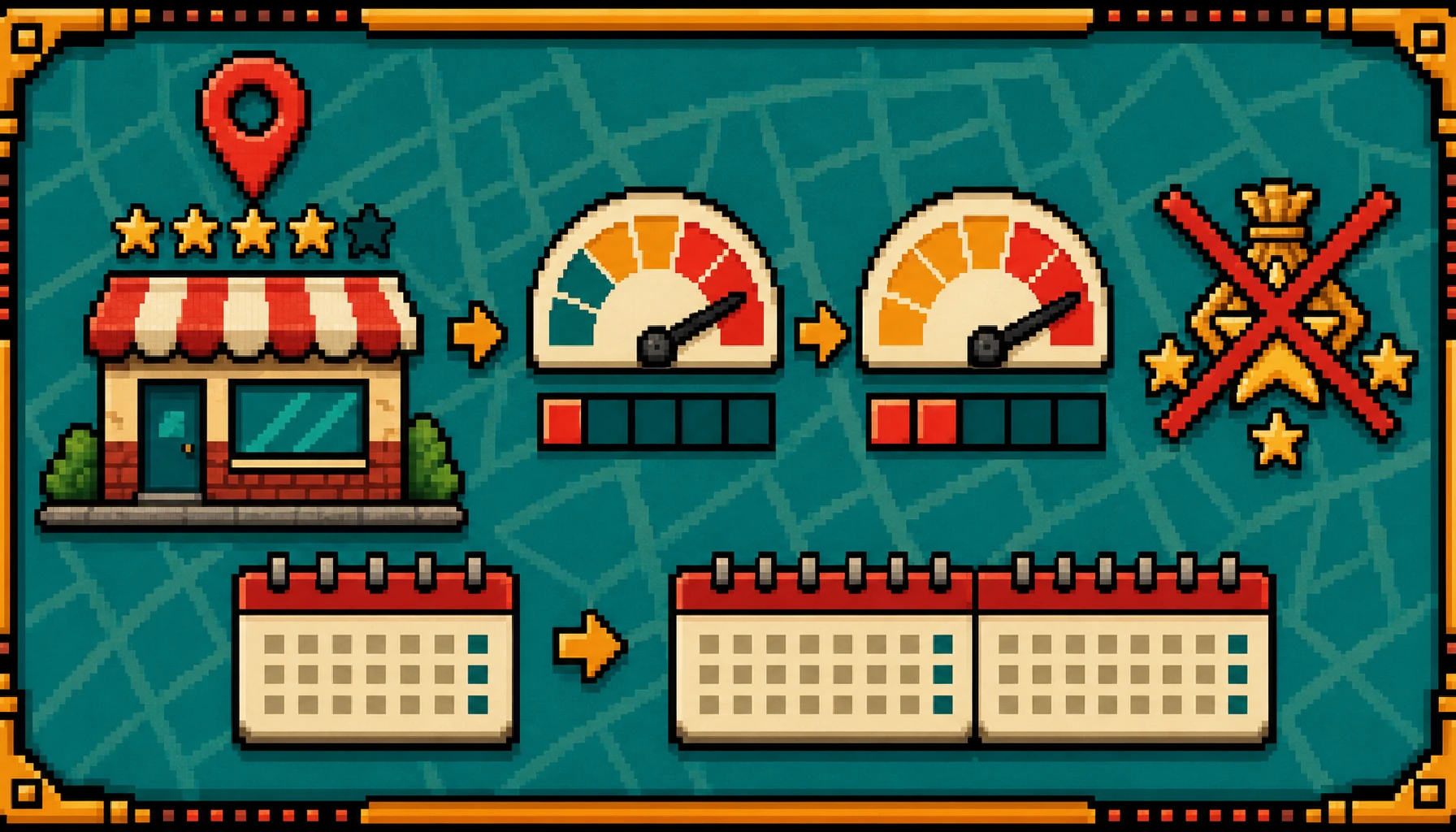
Google has confirmed in practice that Google Business Profile (GBP) penalties are additive. A first fake-engagement violation might restrict your reviews for one month — but get caught again for the same behavior and Google can double it to two months (and presumably keep escalating). For any local business, this raises the stakes on review practices sharply. Here is what triggers it, why it hurts local rankings, and how to keep your profile clean.
What Changed
Local-search expert Ben Fisher surfaced a real Google Business Profile restriction notice (early July 2026) showing that Google explicitly treated a new violation as additional to prior ones. The email a business received read, in part:
“We recently found additional incentivised reviews associated with your profile. These are in addition to the reviews we previously identified to you and constitute a new violation. This violates our fake engagement policy and isn’t allowed. Customers won’t be able to post new ratings and reviews or see past ratings and reviews for 2 months.”
The key phrase is “in addition to.” Previously, a review-policy violation typically drew a one-month restriction. This case shows a repeat offense drawing two months — the penalty stacked because the business kept doing the same thing. During a review restriction, customers cannot leave new reviews and cannot see existing ones, and searchers see a warning that suspicious reviews were removed.
This lands alongside two other early-July local signals worth noting: many businesses reported legitimate reviews temporarily going missing (a separate display issue), and Google is testing a new local “Places” layout. The additive-penalty confirmation is the one with real, lasting consequences.
Why It Matters for Local Rankings
Reviews are a core local-ranking and conversion asset. Google’s local ranking blends relevance, distance, and prominence — and review quantity, quality, and recency feed prominence. A review restriction hits you three ways at once:
- Ranking pressure: You stop accumulating fresh reviews, so your review velocity flatlines while competitors keep gaining — a relative decline in the local pack and Maps.
- Conversion collapse: During a restriction, past reviews are hidden and searchers see a “suspicious reviews removed” warning. Even if you still rank, click-to-call and direction requests drop because the profile looks untrustworthy.
- Compounding downside: Because penalties now stack, a second offense does not just repeat the pain — it extends it, and the trust warning lingers longer.
This is a Google Business Profile / Google Maps policy mechanism specifically. But the underlying lesson — that manipulated reviews are a liability, not an asset — applies to every review surface (Bing Places, Yelp, industry directories) that AI answer engines and search engines increasingly cite for local intent.
What to Do About It: A Prioritized Action Plan
1. Stop every form of incentivized or fake review immediately
Google’s fake-engagement policy prohibits reviews you solicited in exchange for anything of value — discounts, gift cards, freebies, contest entries, or “leave us 5 stars and get 10% off.” Kill any such campaign today, including third-party services that promise reviews. This is the single behavior that triggered the stacking penalty.
2. Audit how you currently ask for reviews
You can ask happy customers for honest reviews — that is allowed and encouraged. What is banned is conditioning the ask on a reward or gating it (only asking customers you know are happy). Rewrite request scripts, receipts, follow-up emails, and signage so they invite an honest review with no incentive attached.
3. Remove review gating from your funnel
“Review gating” — routing satisfied customers to Google while diverting unhappy ones elsewhere — violates policy. If any tool or landing page does this, disable it.
4. Vet your marketing vendors
Many GBP penalties come from an agency or lead-gen vendor buying or incentivizing reviews without the owner’s knowledge. Ask every vendor in writing whether they solicit incentivized reviews, and stop any that do. You own the penalty regardless of who caused it.
5. If you are already restricted, appeal — and fix the root cause first
Use the appeal link in the restriction email. But an appeal without changing the underlying behavior invites the next, longer restriction. Clean up first, then appeal, then keep records showing the practice has stopped.
6. Build a compliant, durable review engine
Replace incentives with volume and timing: ask every customer at the moment of peak satisfaction, make it one tap (share your review link/QR code), and respond to every review. Honest velocity beats risky shortcuts and cannot be penalized.
Common Mistakes to Avoid
- “Just a small discount for a review.” That is an incentivized review = fake engagement. It is exactly what stacks penalties.
- Assuming the penalty resets. It does not — repeat offenses extend, they do not restart at one month.
- Blaming Google for hidden reviews and ignoring the policy issue. A temporary display glitch is different from a restriction; if you got a violation email, that is a policy action you must fix.
- Appealing without changing behavior. You will likely earn a longer restriction next time.
- Trusting a “we’ll get you 50 reviews” vendor. Bought/incentivized reviews are the fastest route to an additive penalty.
- Gating reviews by sentiment. Sending only happy customers to Google is a violation.
Quick-Win Checklist
- Immediately end any incentive-for-review offer (discounts, gift cards, freebies, contests).
- Rewrite all review requests to ask for honest feedback with no strings attached.
- Disable any review-gating tool or landing page in your funnel.
- Get written confirmation from every marketing vendor that they do not buy or incentivize reviews.
- If restricted: fix the cause, then file the appeal from the notice email.
- Stand up a compliant “ask everyone, make it one tap, reply to all” review routine.
- Monitor GBP notifications and your review count weekly to catch issues early.
Local prominence is won the honest way — pair a clean review engine with the tactics in mastering local SEO with Chrome’s geolocation override, and fold it into the wider JSB Media Plan so your local visibility compounds instead of collapsing under a penalty.